
The qu sound jolly phonics teaches is one of the easiest patterns for children to spot once they know the trick: in English, the letter q is never on its own — it always travels with a u right after it. It opens Group 7, the final group of the original 42 Jolly Phonics sounds, and most children meet it at about age 5 to 5 and a half, usually not long after they have learned sh.
This guide covers exactly how to say /kw/, the Jolly Phonics action that goes with it, real words to practice at the start and in the middle of words, a free tracing worksheet, and a few two-minute games you can run at home today.
How to Say /kw/ and the Action That Goes With It
Qu is really two sounds said quickly together: a voiceless k made at the back of the tongue, followed straight away by a rounded w. Say “cap,” then “will,” then squeeze them into a single beat — that is /kw/. The Jolly Phonics action makes this physical: the child shapes both hands like a duck’s beak, opening and closing it while saying qu, qu, qu. A simple cue song helps too — sing “the duck says qu, qu, qu” to the tune of Old MacDonald while the hands snap open and shut on every qu.
Children often confuse qu with a plain c or k, and on paper the letter shapes q, g and p get mixed up as well. If a child writes “quick” as “kwik,” that is actually good listening — the spelling just needs the qu rule taught directly. A fast way to check: cover the u. If the word still needs a w sound to be right (quick, not just “kick”), it is qu. For a full walkthrough of the teaching method, see our guide on how to teach Jolly Phonics step by step.
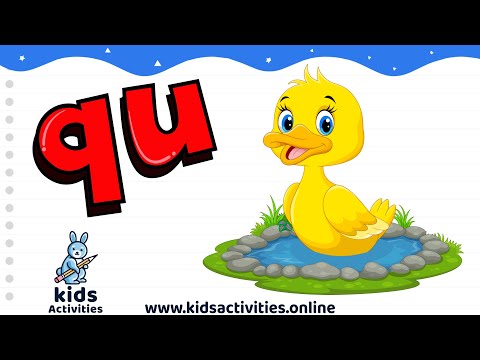
A Qu Sound Story

Jimmy spends every afternoon by the pond behind his house, where the ducks paddle in quick little circles. He tosses them stale bread and they come quacking straight at him, qu, qu, qu, bumping beaks to grab the biggest pieces first. His favorite duck, a plump white one, always arrives last but quietest, so Jimmy saves her the biggest crust. When she finally waddles up, she gives one soft “qu” of thanks before diving back into the pond.
Ways to Spell /kw/
There is really only one everyday spelling to teach at this stage: qu, as in queen, quick, quiz, quack and quilt. English spelling simply does not allow a q without a u after it, so once children learn the pair, they can read it correctly almost every time they meet it.
Words With the /kw/ Sound
At the Start of a Word
- queen
- quick
- quiz
- quack
- quilt
- quit
- quiet
In the Middle of a Word
Qu shows up in the middle of some genuinely useful words too:
- liquid
- squid
- equal
- mosquito
- request
At the End of a Word
Honestly, /kw/ almost never finishes an English word. Words that look like exceptions, such as “unique” and “antique,” actually end in a silent e after que and belong to a spelling pattern taught much later. For beginning readers it is simplest — and accurate — to say the qu sound only starts words or sits in the middle.
Blending Practice
Sound out each word group by group, then blend it together:
- qu-i-t → quit
- qu-i-z → quiz
- qu-i-ck → quick
- qu-a-ck → quack
- qu-i-ll → quill
Watch-Out Words
- quay — said like “key”
- queue — four almost-silent letters tacked onto qu
- acquire — the qu hides mid-word, easy to miss
Four Quick Activities for Today
- Sound hunt (2 minutes): find qu things around the house — a queen figure, a quilt, a quarter.
- Sort the spellings (3 minutes): mix c, k and qu flashcards and sort by starting sound.
- Blend with flashcards (5 minutes): use the cards below to build quick, quack and quiz.
- Dictation (3 minutes): say queen, quick, quiz, quack, quilt and quit; your child writes each one, then you check together.
Blending With Flashcards
Use our Phase 2 and Phase 3 flashcards for this (see our note on phonemes and graphemes if the terms are new). Ask your child to point to the card making the “qu” sound, then build “quick” letter card by letter card.


Free Qu Sound Worksheet
Here’s the digraph “qu” tracing worksheet to practice:

You can also grab the whole set of Phase 3 flashcards below for more dictation words.
Where /kw/ Sits in the Sequence
Qu opens Group 7, the final group of Jolly Phonics’ 42 sounds (qu, ou, oi, ue, er, ar). Most children reach it right after the /sh/ sound, which is worth reviewing if it still feels shaky. Next in line is the /ow/ sound as in cow and shout. For the full 42-sound order and more teaching tips, see the Jolly Phonics complete guide.
Frequently asked questions
What sound does qu make in Jolly Phonics?
It makes /kw/, a k sound blended straight into a w sound, as heard at the start of queen, quick and quack.
Why is there always a u after q?
English spelling rules do not allow a lone q. The u is part of the same unit and, together with q, spells the /kw/ sound, so children should learn “qu” as one pair rather than two separate letters.
How do I tell qu apart from a plain c or k sound?
Listen for the little “w” glide right after the k. Say “kick” and “quick” side by side — if the second sound needs rounded lips to finish, it is qu, not a plain c or k.
What age do children usually learn the qu sound?
Most children meet it at about 5 to 5 and a half, near the end of Group 7 teaching in Jolly Phonics, once earlier digraphs like sh are secure.


