
Parents searching for ee/or sounds jolly phonics help are looking at the last pair in Group 4: two vowel sounds, ee and or, taught side by side even though they sound nothing alike. Both usually arrive around 4 and a half to 5 years old, once a child is already blending simple three-letter words.
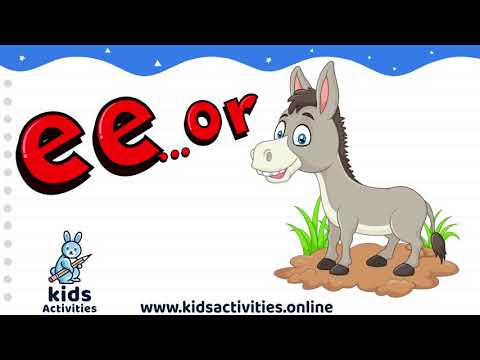
They are taught together because Jolly Phonics gives the pair one shared action: a donkey’s bray, ee-or, ee-or. This guide covers how to say each sound, real word lists, four quick activities, and both worksheet links.
Meet the Donkey: One Bray, Two Sounds

On the farm, the sheep, the cow, and the hen noticed the donkey was missing. They found him by the gate feeling poorly, calling out in a small, croaky voice: ee-or, ee-or. The animals stayed close all night, and by morning he was back on his feet, braying a loud, happy ee-or, ee-or across the yard. That one sound is exactly how Jolly Phonics gets children to remember both letters at once.
How Each Sound Is Made
The ee sound
To make ee, spread your lips into a smile, lift your tongue high at the front of your mouth, and keep your voice on, as in see or tree. For the action, children lift both hands beside their head like donkey ears and say the first half of the bray, ee.
The or sound
or is completely different: round your lips, open your mouth about halfway, and pull your tongue low and back, as in fork or corn. The second half of the action finishes the job: hands stay up as ears while the voice drops into the or half of the bray.
Watching the letters take shape helps some children lock in the sound, so trace along with these two short animations first.


This short video walks through the ee mouth shape one more time:
Because ee and short i sound close together, children often mix up sheep and ship: ee needs a longer, smiling mouth shape, while short i is quick and relaxed. or gets confused with ar the same way, since for and far differ mainly in tongue height, so compare the two out loud. A quick cue song helps too: sing “ee, ee, ee, ears up high” to any tune, then “or, or, or, round lips once more.”
ee is also spelled ea (sea, read) and e (he, me), with y (happy) coming later. or is spelled or for now, with aw (saw) and au (autumn) added later. Click here to know how to teach Jolly Phonics step by step.
Word Lists for ee and for or
ee words
The ee spelling almost never opens an English word. eel is really the only simple example a beginner will meet, so we won’t force a longer beginning list here.
Middle: sheep, feet, green, sleep, sweet, teeth, queen, seed
End: see, bee, tree, free, three, knee, agree, coffee
Blending: s-ee-d → seed, f-ee-t → feet, sh-ee-p → sheep, tr-ee → tree
Watch out: been is spelled with ee but is often said closer to “bin.”
or words
Beginning: or, order, orbit, organ, ornament, orca
Middle: fork, corn, storm, short, sport, north, horse, thorn
End: for, nor — and that is about it. Words like doctor, color and actor end in a soft, unstressed er, not the full or sound, so leave them out for now
Blending: c-or-n → corn, f-or-k → fork, sh-or-t → short, s-p-or-t → sport
Watch out: word and work look like they should say or, but the w in front pulls the sound over to er instead.
Four Quick Practice Activities
- Sound hunt (3 minutes): sort household objects into an ee pile (keys, feet, sheep toy) and an or pile (fork, cord, storm).
- Flashcard word build (5 minutes): use the phase 2 and phase 3 flashcards below to build “feel,” then rebuild the cards into “corn.”
- Grapheme table blend (4 minutes): write letters t, s, d, r, m, f, b with ee, and b, h, d, c, n, k, f with or, using the graphemes table. Say “meet” or “born” and have your child build it.
- Dictation (3 minutes): say meet, seed, storm, born, sheep, and fork slowly and have your child write each one down.


From these three cards the child should build “feel.” Then try “corn” using the cards below.


Worksheets and Printables
Here is the ee worksheet, then the or worksheet, each with its own download button below.


For a dictation warm-up, say meet, storm, sheep, and short slowly and have your child write each on a blank page first.
More free downloads
Where ee and or Sit in the Jolly Phonics Order
These two sounds close out Group 4, right after the /oa/ sound. Once your child is comfortable with ee and or, the next stop is the /ng/ sound. For the full run of all 42 sounds in order, see the Jolly Phonics complete guide.
Frequently asked questions
What are the ee and or sounds in Jolly Phonics?
They are the two vowel sounds that close out Jolly Phonics Group 4, taught with the donkey’s ee-or bray action even though ee, as in tree, and or, as in fork, are made in very different parts of the mouth.
Why does Jolly Phonics teach ee and or in the same lesson?
Group 4 ends with these two sounds sharing one memorable action, so the program pairs them in a single lesson, not because the sounds are related.
How can my child tell or and ar apart?
Say for and far side by side: or keeps the tongue low with rounded lips, while ar opens the mouth wide with no lip rounding at all. Comparing pairs of words out loud is the fastest fix.
What comes after ee and or in the Jolly Phonics sequence?
The next sound most children meet is ng, as in ring and sing, which never appears at the start of an English word.


