
The ai sound jolly phonics teaches is the first vowel digraph most children meet, right after they finish Group 3. If your child can already blend sounds like c-a-t and r-u-n, the next step is learning that two letters, “a” and “i”, team up to make one long sound: the one in rain, train, and tail.
In Jolly Phonics, /ai/ opens Group 4 (ai, j, oa, ie, ee, or), and most children are ready for it around four and a half to five years old, once the sounds from Groups 1 through 3 feel automatic. Below you will find the official action, honest word lists, four quick activities, and a free printable worksheet.
How to Say /ai/ and the Jolly Phonics Action
To say /ai/, start with your mouth half open, the way you would to say the “e” in bed, then glide it up toward “ee”, keeping your voice on the whole time. It is a gliding sound, not a flat one, so let it move.
The Jolly Phonics action for this sound is to cup a hand behind your ear as if you cannot hear, saying “ai? ai?” A lot of families turn that into a quick chant: cup your ear, say “ai, ai, what did you say?” and point to something in the room that has the sound, like the rain outside or a snail on a card.

The easiest sound to confuse with /ai/ is short “a” (ran vs. rain, pan vs. pain). A quick check: short “a” is over almost instantly, while /ai/ glides and you can hold it a beat longer. If your child can stretch it out, they have the digraph.
Watch a short pronunciation video:
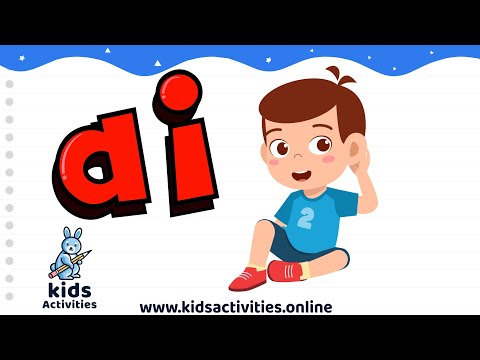
The Ai Sound Story

Kai loved his headphones and wore them every day after school, cartoons turned up loud. “Kai, dinner!” his mom would call, and he would just say “ai? ai?” and cup his ear, unable to hear her over the noise. One rainy afternoon she sat him down and turned the volume knob back herself. “We will save your ears,” she said, and from then on Kai kept the sound low enough to hear the rain on the window, and his mom, the first time she called.
Ways to Spell the /ai/ Sound
Children meet three main spellings of this sound as they progress: ai in the middle of a word (rain, train, tail, paint), ay at the end of a word (day, play, say), and later, once they reach the split digraphs, a-e (cake, name). A simple position rule helps a lot here: ai never ends an English word, and ay never starts one. It is also a vowel digraph, meaning two letters that make one sound together.
Word Lists You Can Trust
Every word below genuinely contains the /ai/ sound, so read them together and let your child hear the glide each time.
- Beginning: the letters “ai” almost never open an English word, but the same sound does, spelled with a plain “a”: aim, aid, ape, apron, acorn, angel.
- Middle (ai): rain, train, tail, paint, snail, chain, wait, brain, plain, mail.
- End (ay): day, play, say, stay, way, tray, gray, spray.
CVC-style blending: r-ai-n → rain; p-ai-n → pain; t-ai-l → tail; m-ai-d → maid; d-ay → day; p-l-ay → play.
Watch-out words: said looks like it should rhyme with maid, but it is really “sed”; again is often said with a short “e” rather than the long /ai/; captain has ai in the middle, but it is squashed down to a quick “in” sound, not the full glide.
Four Games for This Week
- Sound hunt (3 minutes): walk through the house spotting anything connected to rain, mail, a snail, or a tray, saying each word slowly and stretching the /ai/.
- Sort the spellings (4 minutes): write “ai” and “ay” on two cards; call out rain, day, tail, play, wait, stay and have your child point to the matching card.
- Flashcard blending (5 minutes): use the letter cards below to build train, rain, and pain, sliding the ai card in and out of the word.
- Quick dictation (2 minutes): say rain, tail, day, and play one at a time and have your child write each word, then check them together.
Free /ai/ Worksheet and Flashcard Practice
Here is the /ai/ tracing worksheet to print and practice:

For blending practice, line up these flashcards and let your child work out which combination makes a real word.


Arranged correctly, those four cards spell “train.” For a written dictation game, write out a small table of graphemes your child knows, say a word such as “maid” out loud, and have them build it from the table using listening and blending alone.
Where /ai/ Sits in the Jolly Phonics Sequence
/ai/ comes right after the /b/ sound, the last sound in Group 3, and it is followed by the /j/ sound. For the full 42-sound roadmap, see the Jolly Phonics complete guide.
| ai | p | t | r |
| l | m | n | b |
Frequently asked questions
What is the ai sound in Jolly Phonics?
It is the first vowel digraph in Group 4, made when the letters a and i work together to make one long, gliding sound, as heard in rain, train, and tail.
How do you say the /ai/ sound correctly?
Open your mouth halfway as if saying the e in bed, then glide it up toward ee while keeping your voice on the whole time, so the sound stretches rather than stays flat.
What is the difference between ai and ay?
They make the same sound, but ai is used in the middle of a word, such as rain or paint, while ay is used at the end of a word, such as day or play.
What age do kids usually learn the ai sound?
Most children meet it around four and a half to five years old, once they are comfortable blending the single sounds and digraphs taught in Groups 1 through 3.


